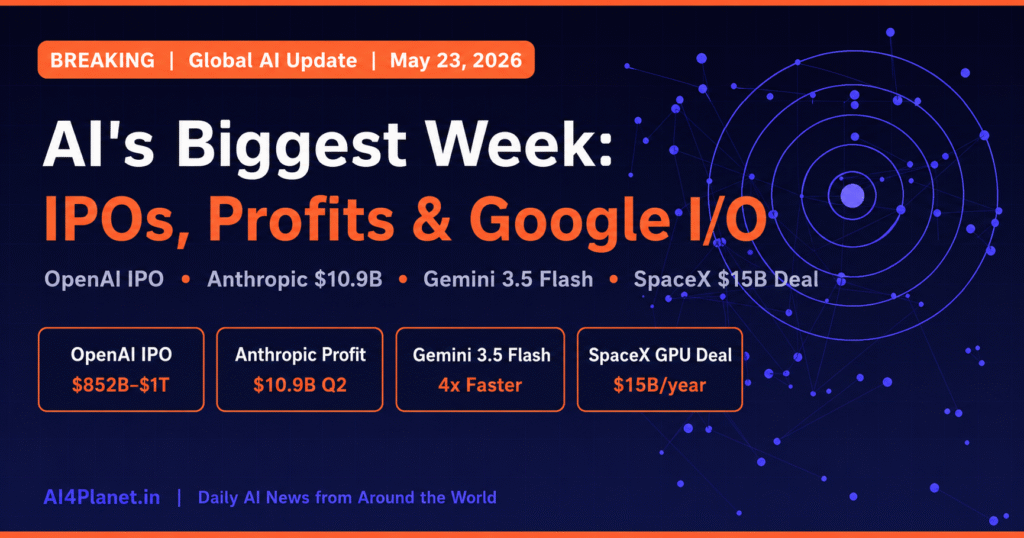

Some weeks in AI feel like background noise. This week was not one of them. In just five days, OpenAI filed for a historic IPO, Anthropic projected its first-ever quarterly profit, Google I/O 2026 redefined what an AI assistant can be, and a buried line in SpaceX’s stock market filing revealed that Anthropic is spending $15 billion a year on GPU compute. Let’s break it all down — no jargon, no hype, just the facts and what they mean for you.
🚀 1. OpenAI Files for IPO — The Biggest Tech Listing in a Generation
It’s official. OpenAI has filed a confidential draft registration statement (S-1) with the U.S. Securities and Exchange Commission, targeting a public listing as early as September 2026. The company is expected to debut at a valuation of $852 billion to $1 trillion — which would make it one of the largest IPOs in history, second only to SpaceX.
Goldman Sachs and Morgan Stanley are leading the process. The filing is “confidential,” meaning financial details won’t be public until approximately 15 days before the roadshow. OpenAI’s pitch to investors centres on ChatGPT’s 900+ million weekly users, the GPT-5.5 model family, and a new $4 billion Deployment Company targeting enterprise revenue.
“OpenAI is preparing to confidentially submit a draft registration statement for an initial public offering to the SEC as early as May 22, with the offering expected to rank among the largest IPOs in history.”
— CNBC & Wall Street Journal, May 20, 2026
The timing is notable. SpaceX filed its own public S-1 on May 20, targeting a Nasdaq listing under ticker SPCX by late June at a valuation of approximately $1.75 trillion. And Anthropic is separately targeting an October 2026 IPO at a $900 billion valuation. Within six months, the three companies most responsible for the current AI revolution will all be publicly traded — representing a combined market cap of roughly $3.7 trillion.
📌 Why it matters: The AI industry is leaving the venture-capital era and entering public markets. When OpenAI files its S-1 publicly, we’ll see audited financials for the first time. That transparency will reset how investors, governments, and the public understand AI economics — for better or worse.
💰 2. Anthropic Projects First-Ever Profit — But There’s a Catch
In a stunning turnaround, Anthropic has told investors it expects to generate $10.9 billion in revenue in Q2 2026 — more than double its $4.8 billion Q1 figure — and to post its first-ever operating profit of $559 million in the process. Less than a year ago, Anthropic was telling investors it didn’t expect profitability until 2028. That story has changed dramatically.
The growth is real — outpacing Google and Facebook in the periods leading up to their own IPOs. Anthropic is currently raising at a $900 billion valuation, surpassing OpenAI’s $852 billion March figure. On the enterprise side, Anthropic has already surpassed OpenAI in business AI adoption — in March 2026, 65% of new enterprise AI contracts went to Anthropic, with only 32% choosing OpenAI.
But here’s the catch, buried in SpaceX’s IPO filing: Anthropic is paying SpaceX $1.25 billion per month for GPU compute access at SpaceX’s Colossus and Colossus II data centres in Memphis, Tennessee — a deal running through May 2029 worth $15 billion per year. The Q2 profit figure benefits from a discounted ramp-up rate in May and June. At the full rate, Anthropic’s compute bill alone will consume a significant share of its revenue.
📌 Why it matters: Anthropic’s profitability story is impressive but nuanced. The real test will come in Q3 and Q4 when the full $1.25B/month compute bill kicks in. Whether Anthropic can grow revenue faster than its infrastructure costs is the defining question for its IPO valuation.
🔍 3. Google I/O 2026 — AI Is Now the Infrastructure, Not a Feature
Google’s annual developer conference (May 19–20) was arguably its most significant in a decade. CEO Sundar Pichai set the tone early: “AI should not be a destination you visit — it should be the infrastructure you live inside.” Here’s what they delivered:
- Gemini 3.5 Flash — Google’s new flagship model, claimed to be 4x faster than competing frontier models at half the cost, with major gains in coding and reasoning. Available now for Google AI Plus, Pro, and Ultra subscribers. Google is now processing over 3.2 quadrillion tokens per month — up from 480 trillion at I/O 2025.
- Gemini Spark — A personal AI agent that runs 24/7 in the cloud, monitoring your emails, calendar, and files and proactively completing tasks. Think of it as an AI chief of staff that never sleeps.
- AI Mode in Google Search — The biggest redesign of Google Search in 27 years. AI Overviews now has 2.5 billion monthly active users. The new AI Mode replaces the classic search results page with a conversational, structured AI response.
- Docs Live — Speak naturally, and Gemini turns your words into a structured document automatically. No prompts needed.
- Ask YouTube — AI-powered search across YouTube’s entire catalogue, turning it into an interactive assistant rather than a video library.
- Samsung XR Glasses — AI-native smart glasses shipping in Fall 2026.
- Google AI Ultra — A new $100/month tier with access to all Gemini models, Gemini Spark, 30TB storage, and priority processing. For context: ChatGPT Pro is $200/month, Claude Max starts at $100/month.
📌 Why it matters: Google has 900 million Gemini users and 2.5 billion Search users. When Google embeds AI this deeply into Search, Docs, YouTube, and Gmail, it’s not launching features — it’s rewriting the digital habits of billions of people. This is the most consequential Google I/O in years.
🛰️ 4. SpaceX’s S-1 Reveals the $15B/Year Secret Powering Anthropic
When SpaceX filed its public S-1 prospectus on May 20, most headlines focused on rockets and Starlink. But buried in the filing was one of the most revealing data points of the AI week: Anthropic is paying SpaceX $1.25 billion per month for compute access to the Colossus 1 and Colossus 2 data centres — a deal running through May 2029.
The Colossus facilities in Tennessee and Mississippi house roughly 100,000 H100 GPUs and 220,000 GB200/GB300 chips — among the largest single AI compute clusters on the planet. The deal makes Anthropic xAI’s largest external client, and the $40 billion total contract is SpaceX’s core AI revenue source for 2026. There is, however, an unusual clause: either party can cancel with just 90 days’ notice — making the entire arrangement more fragile than the headline number suggests.
📌 Why it matters: This deal reveals just how desperate frontier AI labs are for compute — and how much leverage infrastructure owners now hold. Whoever controls the GPUs controls the future of AI development. SpaceX, NVIDIA, and a handful of hyperscalers now sit at the top of the AI power pyramid.
📊 5. Chinese AI Hits 60% of Global Usage — The West Takes Notice
A quietly alarming data point emerged this week: Chinese AI models now account for 60% of all AI usage on OpenRouter, one of the world’s largest multi-model API platforms. Meanwhile, CNBC published a detailed warning that cheap Chinese AI could derail the $800B+ IPO valuations of both OpenAI and Anthropic — raising questions about whether frontier model pricing is sustainable when lower-cost alternatives exist.
Separately, the White House AI Executive Order — which had been widely expected to reshape AI regulation in the United States — was postponed again. President Trump cited dissatisfaction with certain provisions, saying simply: “I didn’t like certain aspects.” The delay adds more regulatory uncertainty to an industry already navigating a complex global policy landscape.
📌 Why it matters: If 60% of global AI API usage is already running on Chinese models, the competitive pressure on US AI labs is real — not theoretical. And without a clear US regulatory framework, the global AI race is being run without a rulebook.
📋 This Week at a Glance
| Story | What Happened | Impact |
|---|---|---|
| OpenAI IPO Filed | Confidential S-1 with SEC, $852B–$1T valuation | 🔴 Critical |
| Anthropic $10.9B Q2 | First-ever projected operating profit of $559M | 🔴 Critical |
| Google I/O 2026 | Gemini 3.5 Flash, Gemini Spark, AI Search overhaul | 🔴 Critical |
| SpaceX GPU Deal | Anthropic pays $1.25B/month for Colossus compute | 🔴 Critical |
| Chinese AI 60% Share | Dominates OpenRouter global usage | 🟡 High |
| White House AI EO | Postponed again by Trump administration | 🟡 Medium |
✍️ Editor’s Take
This week felt like a hinge point. For years, the AI industry operated on venture capital’s terms — massive burn rates, opaque financials, sky-high private valuations, and a shared understanding that profitability was a problem for later. That era is ending. When OpenAI’s S-1 goes public and Anthropic’s quarterly numbers face institutional investor scrutiny, the rules of the game will change permanently.
Google I/O reminded everyone that the biggest AI company in the world by user reach isn’t OpenAI or Anthropic — it’s Google. And when Google decides to rebuild Search, Docs, and YouTube around AI simultaneously, it shapes the digital experience of half the planet. Watch this space very closely in the weeks ahead. The IPO season is just beginning, and the numbers that come out of it will define AI’s next chapter.
Follow our AI4Planet Weekly News and IndiaAI Mission pages for daily updates. Have a story tip? Drop it in the comments below.
Tags: Global AI Update May 2026, OpenAI IPO 2026, OpenAI S-1 SEC filing, Anthropic $10.9 billion revenue, Anthropic first profit, Google I/O 2026, Gemini 3.5 Flash, Gemini Spark, SpaceX Anthropic compute deal, Chinese AI models OpenRouter, White House AI executive order, AI IPO 2026, AI news May 23 2026