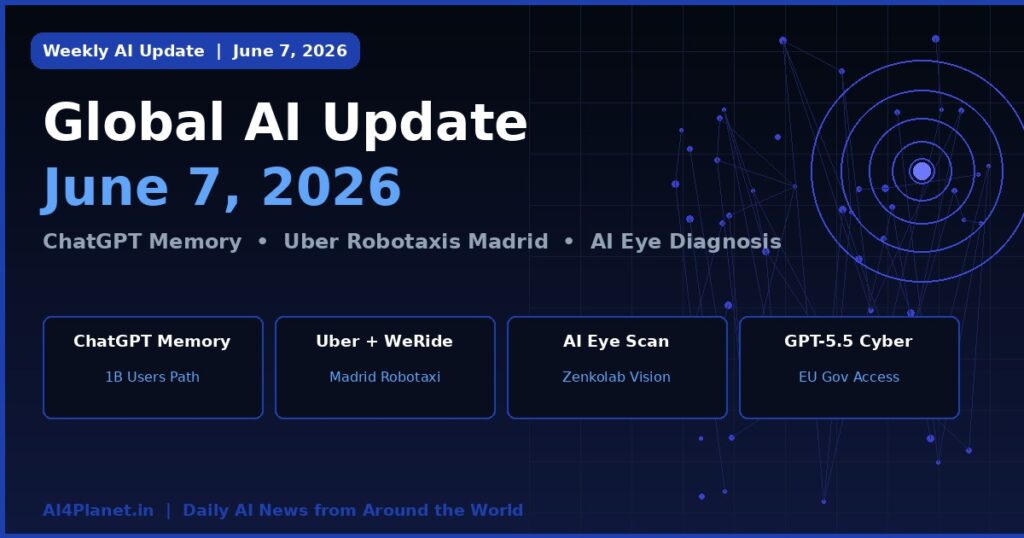

The first week of June 2026 delivered a set of stories that cut across healthcare, transport, consumer AI, and geopolitics — all at once. ChatGPT overhauled its memory system and is now on the verge of one billion users. Uber and WeRide launched Europe’s first commercial robotaxi pilot in Madrid. A French startup is using AI to detect eye disease before symptoms appear. And OpenAI gave the EU access to GPT-5.5-Cyber — a direct counter to Anthropic’s classified Mythos programme. Here is the week, clearly explained.
🧠 1. ChatGPT Rewrites Its Memory — And Brings It to Free Users for the First Time
On June 4, OpenAI published a major upgrade to ChatGPT’s memory system — the most significant architectural change to how the AI remembers you since the feature launched in April 2024. The new system, built on a mechanism called Dreaming V3, solves two long-standing problems: memories going stale over time, and the AI storing contradictory or outdated information about you.
The practical difference is meaningful. Previously, if you told ChatGPT you were travelling to Singapore in July, it would remember that — even in August, September, and beyond, long after the trip was over. The new system automatically updates: “You are going to Singapore in July” becomes “You went to Singapore in July 2026” once the date has passed. Memories now stay current, accurate, and useful across multi-year time horizons.
Three major new features came with the update. A readable memory summary page shows you exactly what ChatGPT has synthesised about your preferences, projects, and habits. Memory controls let you add, edit, or delete specific remembered details. And topic settings let you configure which subjects ChatGPT should proactively raise. For Plus and Pro users, memory capacity has doubled. Most significantly — free users are getting memory for the first time, made possible by a 5x reduction in compute cost.
“Memory is what helps ChatGPT learn your preferences, projects, and constraints, allowing future conversations to start from shared context rather than from scratch.”
— OpenAI Blog, June 4, 2026
This update lands as ChatGPT sits at 900 million weekly active users — on pace to become the fastest consumer product in history to reach one billion. OpenAI’s annualised revenue has hit $25 billion, with 50 million paying subscribers worldwide.
📌 Why it matters: Memory is what separates a useful AI assistant from a forgettable chatbot. When ChatGPT remembers who you are, what you’re working on, and what you care about — across weeks, months, and years — it becomes something closer to a genuine personal assistant. This upgrade is a foundational shift in how AI will work for hundreds of millions of people.
🚖 2. Uber and WeRide Launch Europe’s First Commercial Robotaxi in Madrid
This week, Uber and Chinese autonomous driving company WeRide announced the launch of Spain’s first commercial robotaxi pilot in Madrid — their first joint entry into the European market. Riders will be able to hail a WeRide robotaxi directly through the Uber app, with operations expected to begin later in 2026. Fleet management will be handled by Moove Cars Group’s AVOMO, which already operates autonomous vehicle fleets for Uber in the United States.
Madrid’s regional government — the Comunidad de Madrid — is collaborating on the launch, which will initially include safety operators inside the vehicles. The plan is to progressively expand toward fully driverless commercial service as key performance milestones are cleared. Uber CEO Dara Khosrowshahi has stated the company aims to offer robotaxi services in more than ten countries by late 2026. Uber has now committed more than $10 billion to purchasing thousands of autonomous vehicles and taking equity stakes in their developers.
Madrid becomes the 12th city globally to host WeRide’s robotaxi operations, and the first in Europe. The broader European robotaxi race is heating up rapidly — Waymo has identified London and Tokyo as 2026 targets, Lyft and Baidu are planning deployments in Germany and the UK, and Nvidia is partnering with European ride-hailing platform Bolt on an AI-driven autonomous vehicle platform.
📌 Why it matters: The autonomous vehicle industry has been promising European deployment for years. Madrid is the moment it stops being a promise. When robotaxis become available through the Uber app in a major European capital, the technology crosses from novelty to infrastructure — and the regulatory, insurance, and urban planning implications follow fast.
👁️ 3. AI Detects Eye Disease Before You Notice Any Symptoms — Zenkolab’s Breakthrough
French AI health startup Zenkolab made headlines this week with a system that uses artificial intelligence to analyse retinal images and detect certain eye diseases at a stage before patients notice any symptoms. The technology works by scanning the retina — the light-sensitive tissue at the back of the eye — and identifying early-stage markers of conditions that, if caught late, can lead to irreversible vision loss.
The practical ambition is significant: reduce diagnostic delays, improve patient outcomes, and expand access to screening in regions where eye care specialists are scarce. In many parts of the world — including large areas of rural India, Africa, and Southeast Asia — specialist ophthalmologists are simply unavailable. AI-powered retinal screening deployed at pharmacies, clinics, or even via smartphone cameras could change this equation entirely.
Zenkolab’s announcement fits into a broader pattern of AI healthcare breakthroughs this year. Earlier in 2026, researchers published results showing AI-powered echocardiography automating cardiac measurements for earlier heart disease detection, and a transformer model predicting decade-long health risks from routine clinical data. AI is increasingly moving from assisting doctors to performing the first layer of diagnosis independently.
📌 Why it matters: Eye disease caught early is largely treatable. Eye disease caught late can mean permanent blindness. Zenkolab’s system, if it scales, could prevent thousands of cases of avoidable vision loss annually — particularly in underserved populations where specialist access is the bottleneck, not medical knowledge.
🔐 4. OpenAI Gives the EU Access to GPT-5.5-Cyber — The AI Security Race Goes Geopolitical
In a strategically significant move, OpenAI this week granted the European Union access to GPT-5.5-Cyber — a specialised variant of its latest flagship model built specifically for cybersecurity applications. The model is rolling out in limited preview to vetted cybersecurity teams, EU businesses, governments, cybersecurity authorities, and EU institutions including the EU AI Office.
The timing is deliberate. Anthropic launched Claude Mythos Preview through Project Glasswing on April 7, 2026, and expanded the programme on June 2 to cover power, water, healthcare, communications, and hardware sectors — but has not yet granted EU access to Mythos. OpenAI’s EU deployment of GPT-5.5-Cyber is being read across the industry as a direct strategic counter: establishing a European government and enterprise foothold before Anthropic can extend Glasswing to the region.
Meanwhile, developer speculation is running high about Anthropic’s next model release. Evidence for an intermediate Claude Sonnet 4.8 has been circulating since a source map was accidentally shipped with the @anthropic-ai/claude-code npm package in March 2026. A mid-June Sonnet release is widely anticipated in developer communities. With OpenAI, Anthropic, and Google all competing intensely for European government contracts, the frontier AI race has become explicitly geopolitical.
📌 Why it matters: Government AI contracts are long-term, high-value, and sticky. Whichever AI company becomes the infrastructure of choice for EU cybersecurity agencies will have a significant first-mover advantage for years. The race to become Europe’s default AI partner is now as important as the race to build the best model.
🔑 5. Google Wallet Expands to Official Documents — Your Phone Becomes Your Identity
Google is expanding digital identity capabilities within Google Wallet, allowing users in supported regions to store and present certain official government documents — including digital ID cards and driving licences — directly from their smartphones. The move reflects a broader global trend toward AI-powered identity verification and the digitisation of administrative services.
The technology behind digital identity verification increasingly relies on AI — for document authentication, liveness detection (confirming a real person is presenting the document), fraud detection, and cross-referencing against government databases in real time. Google’s expansion here represents AI moving from the consumer layer into civic infrastructure — the systems that verify who you are when you board a flight, enter a government building, or open a bank account.
This week also saw Ramp — one of the fastest-growing financial technology companies in the US — outline its vision for fully AI-driven financial operations, where AI agents handle accounts payable, expense management, vendor negotiations, and financial reporting with minimal human intervention. AI is moving into the back office faster than most business leaders anticipated.
📌 Why it matters: Digital identity is the foundation of the digital economy. When your phone becomes your passport, your driving licence, and your proof of age — secured by AI — the companies that control that infrastructure control access to an extraordinary amount of daily life. Google’s expansion here is about far more than a wallet app.
📋 This Week at a Glance
| Story | What Happened | Impact |
|---|---|---|
| ChatGPT Memory Upgrade | Dreaming V3 system — now coming to free users | 🔴 Critical |
| Uber + WeRide Madrid | Europe’s first commercial robotaxi pilot launched | 🔴 Critical |
| Zenkolab AI Eye Scan | Retinal AI detects disease before symptoms appear | 🟡 High |
| OpenAI GPT-5.5-Cyber EU | EU cybersecurity access — countering Anthropic Glasswing | 🔴 High |
| Google Wallet Digital ID | Official documents storable on smartphone | 🟡 High |
| Ramp AI Finance Vision | Fully AI-driven financial operations roadmap | 🟡 Medium |
✍️ Editor’s Take
This week’s stories share a theme that is easy to miss if you look at them individually: AI is becoming infrastructure. Not a feature, not a product, not a demo — infrastructure. ChatGPT’s memory system is the infrastructure of personal AI. Uber’s robotaxis are transport infrastructure. Google Wallet’s digital ID is civic infrastructure. OpenAI’s EU cybersecurity access is government infrastructure. Zenkolab’s retinal scanner is healthcare infrastructure.
Once AI embeds into infrastructure, it doesn’t leave. The decisions being made this week — which companies win government contracts, which robotaxi platforms get regulatory approval, which AI systems get trusted with your medical screening — will shape the next decade. Pay attention not just to the product launches, but to where the pipes are being laid. That’s where the real story is.
Follow our AI4Planet Weekly News and IndiaAI Mission pages for updates every week. Have a story tip? Drop it in the comments below.
Tags: Global AI Update June 2026, ChatGPT memory upgrade Dreaming V3, Uber WeRide Madrid robotaxi, Zenkolab AI eye disease detection, OpenAI GPT-5.5-Cyber EU, Google Wallet digital identity, AI news June 7 2026, weekly AI news, ChatGPT 1 billion users, AI healthcare 2026, autonomous vehicles Europe