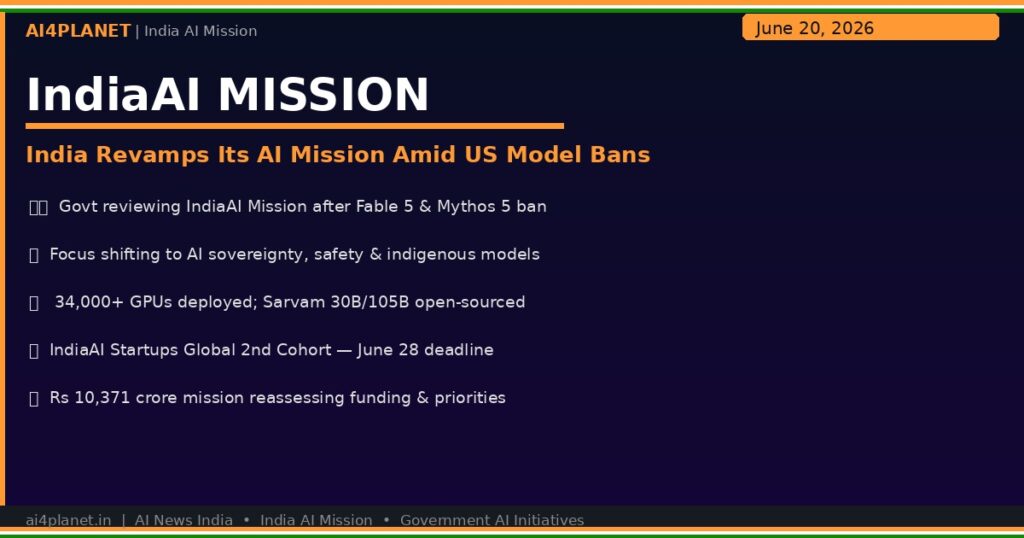

When the US government ordered Anthropic to cut off global access to its Fable 5 and Mythos 5 models on June 12, 2026, it sent a shockwave through India’s tech establishment. India’s Finance Minister Nirmala Sitharaman called it “unprecedented.” Now, the government is doing something about it — rethinking the entire IndiaAI Mission from the ground up.
According to a Financial Express report, detailed consultations are already underway with industry leaders, researchers, and startups to redefine the mission’s objectives. The message from officials is clear: “Technology is the ultimate weapon. National sovereignty, national security — all of it is now about technology.”
Key highlights
- The Indian government is formally reviewing the IndiaAI Mission amid concerns about dependence on foreign AI providers
- The trigger: US export controls forced Anthropic to suspend global access to Fable 5 and Mythos 5 on June 12, 2026
- Discussions are converging around four pillars — sovereignty, safety, talent, and research
- Sarvam AI has open-sourced 30B and 105B models trained on Indian compute, supporting 22 Indian languages
- IndiaAI Mission has deployed 34,000+ GPUs accessible at ~₹65/GPU-hour
- The IndiaAI Startups Global 2nd Cohort (with Station F + HEC Paris) is open — deadline June 28, 2026
What triggered the review
On June 12, 2026, Anthropic announced that a US government directive had forced it to block foreign-national access to its two newest models — Fable 5 and Mythos 5. The order came after scrutiny around Claude Mythos Preview, which Anthropic had positioned as having advanced cybersecurity capabilities.
For Indian technology leaders, the incident exposed a structural vulnerability that had been quietly acknowledged but rarely confronted head-on: India’s AI ecosystem — however impressive its growth — is built on foreign infrastructure, foreign models, and foreign chips. API access, as one analyst put it, is not strategic control.
The Communications Today report confirmed that the government is now overhauling the IndiaAI Mission, reassessing priorities and funding needs. Officials say the focus is shifting toward “building capabilities that ensure our long-term interests are protected.”
What the IndiaAI Mission is — and what’s changing
Approved by the Union Cabinet in March 2024 with a ₹10,371.92 crore outlay, the IndiaAI Mission was built on seven pillars: AI compute, foundation models, datasets, application development, AI safety, startup support, and skills development.
| Pillar | Current Status (Mid-2026) |
|---|---|
| AI Compute | 34,000+ GPUs deployed at ~₹65/GPU-hour |
| Foundation Models | Sarvam 30B & 105B open-sourced; BharatGen (IIT Bombay) in development |
| Datasets | AIKosha data sandbox operational |
| Startup Support | IndiaAI Startups Global 2nd Cohort open (Station F + HEC Paris) |
| Skills | Fellowships for PhD, PG, UG students; AI labs in Tier-2/3 cities |
| AI Safety | Under review — new emphasis on evaluation & auditing |
| Applications | Bhashini multilingual platform: 20 languages, 1M+ downloads |
The review is expected to strengthen all of these, but particularly the safety and sovereignty dimensions. The government wants India to be able to evaluate, audit, and secure AI systems — not just deploy them.
Sarvam AI and the open-source response
One of the brightest spots in India’s AI story this year has been Sarvam AI. The startup open-sourced its 30B and 105B parameter models — trained on IndiaAI Mission compute, optimised for 22 Indian languages. This is real progress: Indian-built, Indian-trained, open to all.
But analysts at ExplainX.ai note an important caveat: Sarvam’s models were trained on relatively modest compute budgets compared to frontier global models. Training a model competitive with the top global systems would require cluster-months of 10,000+ H100-equivalent GPUs — compute India does not yet have at that scale.
Still, for Indian-language applications, enterprise deployments, and government services, these models represent a meaningful alternative to foreign APIs. Bhashini, India’s multilingual AI platform, already delivers voice-based translation across 20 languages and has crossed one million downloads.
The hardware problem India can’t ignore
Here’s the structural tension at the heart of India’s sovereign AI story: the entire IndiaAI Mission compute base runs on NVIDIA chips — hardware subject to US export controls. India is currently Tier 1 under US export control rules, meaning it faces no chip access restrictions. But that status is not guaranteed forever, and a change in US-India relations or US domestic policy could alter things quickly.
China’s AI development offers a cautionary parallel. Cut off from NVIDIA’s top chips, China has had to pivot to Huawei’s Ascend series. India has no equivalent domestic chip alternative ready today. Compute sovereignty — the ability to build and train at scale without dependence on foreign hardware — remains India’s longest-term challenge.
IndiaAI Startups Global — 2nd Cohort now open
Amid the strategic reassessment, the IndiaAI Mission is also pushing forward on its startup agenda. The 2nd Cohort of the IndiaAI Startups Global Acceleration Programme — run in partnership with Station F (world’s largest startup campus) and HEC Paris — is now accepting applications.
| Detail | Info |
|---|---|
| Applications Open | June 15, 2026 |
| Application Deadline | June 28, 2026 |
| Programme Start | September 1, 2026 (tentative) |
| Onsite Phase (Paris) | December 15, 2026 (tentative) |
| Startups Selected | 10 |
| Prize Money | Up to ₹5 lakh per startup |
| Contact | gm-startups@indiaai.gov.in |
Selected startups get office space at Station F, investor meetups, legal workshops for EU market entry, and cross-border collaborations with French and European AI leaders. For Indian AI startups eyeing global markets, this is a rare structured pathway.
Real-world impact
For Indian developers and businesses, the immediate practical implication of the US model ban is simple: if your product depends on a foreign frontier model accessed via API, you carry access risk. That risk just became visible in a way it wasn’t before.
The IndiaAI Mission’s subsidised compute at ₹65/GPU-hour makes it economically viable for startups to fine-tune or train models on Indian infrastructure. Sarvam’s open-source releases give developers a real Indian-language alternative. And the Startups Global programme provides a route to international markets without building everything from scratch.
For enterprises in regulated sectors — banking, healthcare, government — the case for sovereign AI deployments has never been stronger. The question is no longer philosophical; it’s operational.
AI4Planet analysis
India’s IndiaAI Mission review is the right response to a genuine strategic shock. The US model ban was a reminder that API access and compute access are not the same as AI sovereignty. India has made real progress — more GPUs, open-source models, multilingual platforms — but the foundation still rests on foreign hardware and foreign software stacks.
The four pillars being discussed — sovereignty, safety, talent, and research — are the right areas to strengthen. But the timeline matters. Building domestic chip capability is a decade-long project. Training frontier-competitive models requires compute India doesn’t yet have. In the near term, India’s best path is to deepen its open-source model ecosystem, lock in compute access agreements, and invest heavily in evaluation and auditing capabilities — so it can at least verify what foreign systems are doing even when it can’t replace them.
One blind spot worth watching: the IndiaAI Mission has largely focused on compute and model-building. But data quality, governance frameworks, and deployment infrastructure are equally critical. As the rapid proliferation of open-source models changes the landscape, the question isn’t just “can India build models?” — it’s “can India deploy them safely, at scale, for citizens?”
Final thoughts
The US model ban on Fable 5 and Mythos 5 was a wake-up call, not a crisis — but India is right to treat it seriously. The IndiaAI Mission review signals a maturing strategic mindset: from building AI capabilities to owning them. Watch for the revised mission framework announcement, the Startups Global cohort selections, and Sarvam’s next model releases as indicators of where India’s AI sovereignty story is heading next.
Frequently asked questions
Q: What is the IndiaAI Mission?
A: The IndiaAI Mission is India’s flagship AI initiative, approved by the Union Cabinet in March 2024 with a ₹10,371.92 crore outlay. It is built on seven pillars — compute, foundation models, datasets, applications, AI safety, startup support, and skills — with the vision of “Making AI in India and Making AI Work for India.”
Q: Why is the Indian government reviewing the IndiaAI Mission?
A: The review was triggered by the US government ordering Anthropic to block foreign access to its Fable 5 and Mythos 5 AI models in June 2026. The incident highlighted India’s strategic dependence on foreign AI providers and prompted a reassessment of the mission’s priorities around sovereignty, safety, talent, and research.
Q: What are Sarvam AI’s open-source models?
A: Sarvam AI open-sourced two models — Sarvam 30B and Sarvam 105B — both trained on IndiaAI Mission compute and optimised for 22 Indian languages. They represent India’s most significant open-source contribution to the global AI landscape to date.
Q: How many GPUs has the IndiaAI Mission deployed?
A: As of mid-2026, the IndiaAI Mission has deployed approximately 34,000 GPUs across data centres in India, accessible to registered startups, academic researchers, and government agencies at approximately ₹65 per GPU-hour.
Q: What is the IndiaAI Startups Global programme?
A: It is an international acceleration programme run by IndiaAI Mission in partnership with Station F (Paris) and HEC Paris. The 2nd Cohort is currently open for applications (deadline: June 28, 2026) and selects 10 Indian AI startups for mentoring, investor access, and EU market entry support, with up to ₹5 lakh in prize money per startup.
Q: What is Bhashini?
A: Bhashini is India’s AI-powered multilingual platform, providing translation and speech services across 20 Indian languages. It has crossed one million downloads and is being deployed across railway platforms, government services, and digital governance initiatives.
Q: Does India have chip manufacturing capability for AI?
A: Not yet at the scale required for frontier AI training. India’s compute infrastructure runs primarily on NVIDIA chips subject to US export controls. Building domestic chip design and manufacturing capability is a long-term project — likely a decade or more — making this India’s most significant AI sovereignty gap.
Q: How does the US AI model ban affect Indian businesses?
A: Any Indian business or developer whose product depends on a US frontier AI model accessed via API now carries access risk — the possibility that US policy changes could cut off that access. The ban on Fable 5 and Mythos 5 made this risk concrete and visible for the first time.
Follow our AI4Planet Weekly News and AI News pages for updates every week. Have a story tip? Drop it in the comments below — we read every one.