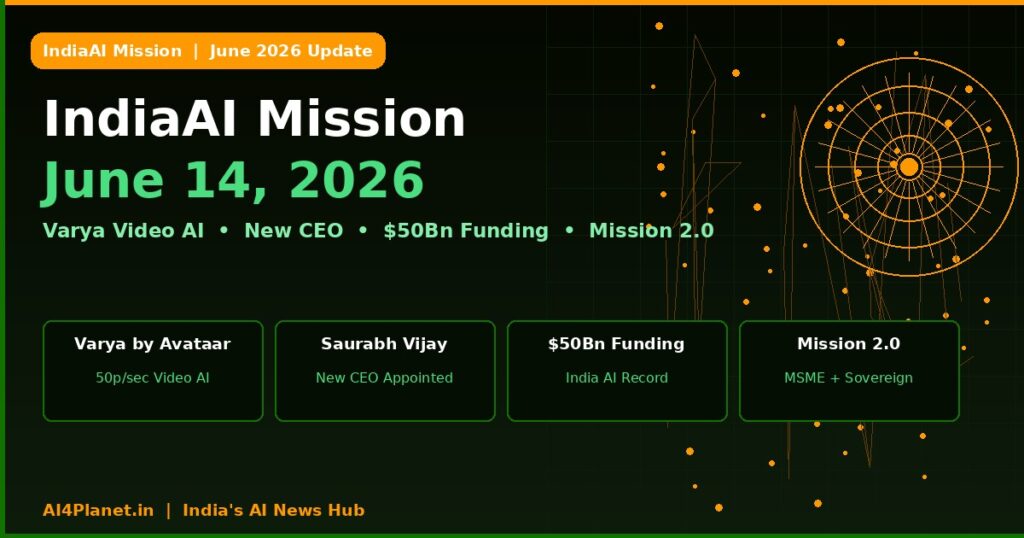

The IndiaAI Mission has had one of its most eventful weeks since launch. In just a few days, Avataar.ai launched Varya — India’s first distilled video AI model, capable of producing frontier-quality video at just 50 paise per second. Saurabh Vijay was appointed the new CEO of the IndiaAI Mission, bringing UIDAI’s digital governance expertise to India’s AI programme. Indian AI startups crossed a $50 billion funding milestone, cementing India’s place among the top three global AI investment destinations. And the government unveiled the broad roadmap for IndiaAI Mission 2.0 — a strategic shift from infrastructure-building to deep R&D, sovereign capability, and MSME adoption at scale. Here is everything that happened, explained clearly.
🎬 1. Avataar.ai Launches Varya — India’s First Distilled Video AI Model at 50 Paise Per Second
On June 12, 2026, Avataar.ai launched Varya — India’s first distilled AI video generation model, developed under the IndiaAI Mission and backed by Peak XV Partners. The launch took place at an event in New Delhi attended by Shri S. Krishnan, Secretary of the Ministry of Electronics and Information Technology (MeitY), alongside Avataar’s leadership team — a clear signal of the government’s ownership of this milestone.
Varya is a 14-billion-parameter distilled model that delivers video generation quality comparable to leading global models such as Alibaba’s Wan 2.2 and Google’s Gemini Veo 3 — but at a fraction of the cost. Video generation on Varya costs approximately 50 paise per second (roughly $0.006), compared to more than $0.10 per second charged by models like Veo, Kling, Luma, and Runway. That is nearly a 20x cost reduction over global rivals, making professional video generation economically viable for small businesses, content creators, educators, and government agencies across India for the first time.
Crucially, Varya is optimised for India’s cultural, linguistic, and regional diversity — an area where global video AI models have consistently failed Indian users. The model understands Indian visual contexts, traditional aesthetics, regional clothing, architecture, and linguistic markers that models trained predominantly on Western data simply cannot represent. Avataar’s ambition is population-scale deployment across three use cases: education content creation, small business advertising, and everyday storytelling — the kind of visual content needs that affect hundreds of millions of Indians who currently have no affordable AI tool to serve them.
“Varya is India’s answer to the global video AI gap — frontier quality at Indian prices, built for Indian contexts. This is what sovereign AI actually looks like in practice.”
— Avataar.ai Launch Event, New Delhi, June 12, 2026
📌 Why it matters: Varya is the clearest proof yet that the IndiaAI Mission’s foundational investments — GPU access, dataset infrastructure, sovereign model funding — are producing real, deployable products. A 20x cost reduction on video AI isn’t incremental. It changes who can afford to create professional video content in India, from large agencies to a street-side small business in Jaipur.
👤 2. Saurabh Vijay Appointed New CEO of IndiaAI Mission — UIDAI’s Digital Governance Expertise Comes to AI
In a significant leadership development, the Government of India appointed Saurabh Vijay — the current CEO of the Unique Identification Authority of India (UIDAI) — as the new CEO of the IndiaAI Mission on June 8, 2026. Vijay is a 1998-batch IAS officer with deep experience in large-scale digital governance, identity infrastructure, and national technology programmes. His appointment brings exactly the kind of execution-at-scale expertise that the IndiaAI Mission needs as it transitions from its infrastructure-building phase to deployment and adoption.
The significance of selecting the UIDAI CEO is hard to overstate. UIDAI built Aadhaar — the world’s largest biometric identity system, covering over 1.3 billion Indians — with government-level security, reliability, and public trust requirements. That infrastructure has become the backbone of India’s digital public goods stack, enabling Jan Dhan accounts, direct benefit transfers, and digital payments at population scale. Bringing this operational DNA to the IndiaAI Mission signals the government’s intent to build AI infrastructure that is similarly robust, accessible, and sovereign — not just impressive in demos, but deployed at Aadhaar-level scale.
Under Vijay’s leadership, the IndiaAI Mission is expected to accelerate in three areas: AI infrastructure deployment (expanding GPU access and data labs), AI for digital governance (applying AI to government services and citizen-facing applications), and indigenous technology development (driving the 12 foundational model projects toward production deployment). The appointment also reflects a broader pattern of the Government of India staffing its most ambitious technology initiatives with administrators who have proven large-scale implementation track records.
📌 Why it matters: The IndiaAI Mission has excellent infrastructure ambitions. The gap — as with many government technology programmes — has often been between announced plans and actual deployment. Saurabh Vijay’s appointment is a direct response to that gap. Someone who built Aadhaar at 1.3 billion scale knows exactly how to take a technology from pilot to population-level deployment.
💰 3. Indian AI Startups Cross $50 Billion in Global Funding — India Enters the Top 3
As of June 3, 2026, Indian AI startups have collectively attracted over $50 billion in global funding — positioning India among the top three global AI investment destinations, alongside the United States and China. The scale of this achievement becomes clear in context: two years ago, India’s AI startup ecosystem was measured in billions, not tens of billions. The IndiaAI Mission’s subsidised compute access, dataset infrastructure, and sovereign model funding have created the conditions for this acceleration.
The global technology giants have taken notice. Microsoft, Google, and NVIDIA have each pledged over $3 billion specifically for India between 2024 and 2026 — investments driven by the country’s combination of AI talent density, English language capability, massive addressable market, and government-backed infrastructure. India produces approximately 1.5 million STEM graduates annually, and the IndiaAI Mission’s AI literacy programme has touched over 13,500 scholars at undergraduate, postgraduate, and doctoral levels.
The infrastructure side of this story is being built domestically too. Netweb Technologies and E2E Networks — two Indian companies — have emerged as key beneficiaries of IndiaAI Mission GPU deployment contracts, building domestic data centre capacity that reduces India’s dependence on foreign cloud providers for AI compute. The 38,000 GPU cluster already operational at ₹65/hour is being supplemented by private sector investments targeting an eventual capacity of hundreds of thousands of GPUs on Indian soil.
📌 Why it matters: $50 billion in AI funding is the market’s verdict on India’s AI potential. But the more important number is the ratio of domestic infrastructure to foreign dependency in that investment. India’s long-term AI sovereignty depends on how much of that capital stays within Indian data centres, trains Indian models, and builds Indian AI companies — not how much flows through Indian offices of American cloud providers.
🚀 4. IndiaAI Mission 2.0 Announced — From Infrastructure to Sovereign Innovation at Scale
Union IT Minister Ashwini Vaishnaw has unveiled the broad roadmap for IndiaAI Mission 2.0 — marking a strategic pivot from the first phase’s focus on infrastructure (GPUs, data, models) to a new phase centred on deeper R&D, sovereign AI capability, and widespread MSME adoption. The announcement coincided with the India AI Impact Summit 2026 at Bharat Mandapam, New Delhi.
The three pillars of Mission 2.0 are clearly defined. Sovereign AI R&D — expanding the 12 foundational model projects, establishing India as a contributor to global frontier AI research rather than just a consumer of foreign models. MSME AI Stack — creating a suite of ready-to-use AI solutions specifically built for India’s 63 million small and medium enterprises, covering areas such as GST compliance, inventory management, vernacular customer service, and export documentation. Inclusive AI Adoption — ensuring that the benefits of AI reach Tier 2 and Tier 3 cities, rural areas, and underserved communities through the 27 India Data and AI Labs already operational and the 543 additional labs identified for rollout.
The MSME focus is particularly significant. India’s 63 million MSMEs employ over 110 million people and contribute approximately 30% of GDP — yet AI adoption in this sector has been negligible, largely because existing AI tools are designed for English-language, large-enterprise contexts. An MSME AI Stack built in India, for India, in Indian languages, at Indian pricing, could be one of the most transformative economic interventions of the decade. The IndiaAI Innovation Challenge 2026 — launched in partnership with MeitY and the MSME Ministry — is already identifying and funding the startups building these solutions, with winners receiving deployment contracts worth up to ₹1 crore.
📌 Why it matters: Mission 1.0 asked: “Can India build AI infrastructure?” Mission 2.0 asks: “Can India make AI work for every Indian?” Those are very different questions. The first is about compute and capability. The second is about distribution, language, relevance, and trust. The answer to the second question will determine whether India’s $1.7 trillion AI GDP projection by 2035 is a realistic forecast or an optimistic aspiration.
📊 IndiaAI Mission — June 2026 Progress Snapshot
| Milestone | Status | Impact |
|---|---|---|
| Varya Video AI (Avataar.ai) | ✅ Launched June 12, 2026 | 20x cheaper than global rivals |
| New CEO — Saurabh Vijay | ✅ Appointed June 8, 2026 | UIDAI-scale execution expertise |
| India AI Startup Funding | ✅ $50 Billion milestone crossed | Top 3 global AI investment hub |
| IndiaAI Mission 2.0 | ✅ Roadmap announced | MSME + Sovereign AI focus |
| GPU Infrastructure | ✅ 38,000 GPUs at ₹65/hr | Accessible compute for all |
| AIKosh Platform | ✅ 5,500+ datasets, 251 models | 385,000+ visits, 11,000 users |
| 12 Indigenous AI Models | ✅ Sarvam + BharatGen live | Sovereign foundational models |
| Innovation Challenge 2026 | 🔄 Applications ongoing | Up to ₹1 Cr deployment contracts |
✍️ Our Take: India’s AI Story Is Entering Its Most Important Chapter
The launch of Varya is the kind of moment that deserves to be marked. Not because 50 paise per second is a headline number — but because it represents something larger: the IndiaAI Mission’s infrastructure investments producing a product that a street vendor in Varanasi could theoretically use to create a professional video advertisement for their business. That is what sovereign AI for India actually means in practice. Not a benchmark score. Not a model parameter count. A tool that costs less than a cup of chai per second of video.
Saurabh Vijay’s appointment and the Mission 2.0 roadmap together signal that the government understands what phase it is now in. Phase 1 was about proving that India could build AI infrastructure. That question has been answered. Phase 2 is about making that infrastructure deliver tangible outcomes for ordinary Indians — in their languages, at their price points, for their problems. That is a harder and more important challenge. The $50 billion in global AI investment flowing into India suggests the world believes India can meet it. We will be watching closely.
🔗 Key Official Links
- IndiaAI Official Portal — indiaai.gov.in
- AIKosh Platform — Access Sarvam LLMs, Varya, Datasets & Models
- IndiaAI Innovation Challenge 2026 — Apply Now
Follow our IndiaAI Mission and AI4Planet Weekly News pages for updates every week. Have a story tip? Drop it in the comments below — we read every one.
Tags: IndiaAI Mission June 2026, Varya Avataar AI video model, Saurabh Vijay IndiaAI Mission CEO, India AI startups $50 billion funding, IndiaAI Mission 2.0, MSME AI stack India, sovereign AI India, AIKosh platform, Sarvam AI, BharatGen IIT Bombay, 38000 GPUs India, India AI news June 2026, MeitY AI initiative