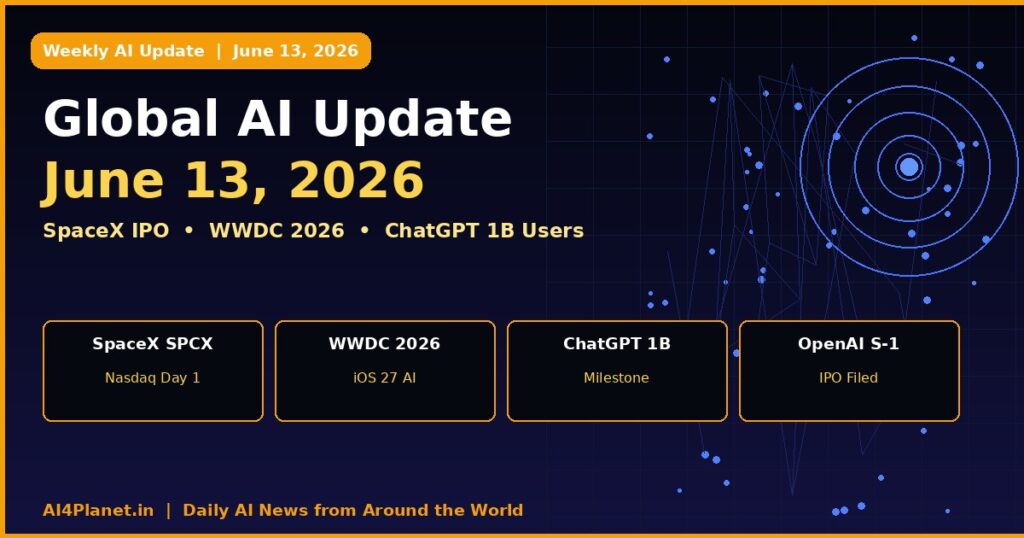

This week, the AI industry crossed several milestones simultaneously — and the convergence is hard to ignore. SpaceX began trading on Nasdaq under ticker SPCX, kicking off what Goldman Sachs projects will be a $160 billion IPO year driven almost entirely by AI-adjacent companies. ChatGPT officially crossed one billion monthly active users — faster than any consumer product in history. Apple’s WWDC 2026 confirmed iOS 27 will be the most AI-forward iPhone software ever shipped. And OpenAI filed its confidential S-1 with the SEC. Here is the week that may look, in hindsight, like the moment AI went from a technology trend to permanent global infrastructure.
🚀 1. SpaceX Lists on Nasdaq as SPCX — The AI Infrastructure IPO Season Officially Begins
On June 12, 2026, SpaceX began trading on Nasdaq under the ticker SPCX — and with it, the most consequential IPO season in a generation officially opened. The listing targeted a valuation of approximately $1.75 trillion, making SpaceX the largest IPO in US market history. But the story for AI watchers isn’t rockets — it’s the xAI division and the compute infrastructure buried inside the S-1.
SpaceX’s xAI division — which includes the Grok model family and the Colossus supercomputer facilities in Memphis and Mississippi — generated approximately $3.2 billion in revenue in 2025 against $14 billion in cash consumption. The S-1 also confirmed that Anthropic is paying SpaceX $1.25 billion per month for compute access to the Colossus 1 and Colossus 2 data centres — a deal running through May 2029 worth $40 billion total. This financial dependency between the world’s most valuable AI startup and the world’s largest IPO creates an extraordinary structural link between the two companies.
The reception wasn’t uniformly euphoric. Morningstar pegged fair value at $780 billion — less than half the target valuation. The S&P 500 rejected a fast-track inclusion rule, costing SPCX approximately $27 billion in forced passive fund buying. The American Federation of Teachers formally asked the SEC to apply extraordinary scrutiny before pension money flows in. Goldman Sachs projects 2026 IPO proceeds could reach $160 billion total — a quadrupling from 2025 — driven almost entirely by SpaceX, Anthropic, and OpenAI. MSCI announced on June 9 that SPCX would begin entering its large-cap indices starting June 13 — the first full trading day after the IPO.
“The convergence of three near-trillion-dollar AI IPOs in a single calendar quarter is unprecedented. Institutional investors have finite capacity to absorb this much new AI equity.”
— AI News Today, June 12, 2026
📌 Why it matters: The SpaceX IPO isn’t just a valuation story — it’s a signal that AI infrastructure is now considered an investable asset class by global capital markets. When institutional money starts flowing into AI compute at this scale, the feedback loop between capital and capability accelerates in ways that are genuinely difficult to predict.
🍎 2. WWDC 2026 — Apple Makes iOS 27 Its Most AI-Ambitious Software Release Ever
Apple’s Worldwide Developers Conference concluded this week, and the headline story is clear: iOS 27, iPadOS 27, and macOS 27 represent the most significant AI integration Apple has ever shipped. The $1 billion annual Gemini licence deal with Google — confirmed on Apple’s balance sheet this week — powers the new Conversational Siri, which can now handle multi-turn dialogue, complex task completion, and deep app integration in ways the previous version simply could not.
The key announcements from WWDC 2026 span every Apple platform. iOS 27 brings Conversational Siri (powered by Gemini), on-device AI photo editing, AI-generated replies in Messages, and a new Extensions framework that lets users choose third-party AI providers — including Claude — to power specific Apple Intelligence features. macOS 27 introduces Writing Tools across every app system-wide, AI-powered Spotlight search that understands intent rather than just keywords, and a significant upgrade to the Photos intelligence engine. visionOS 3 brings spatial AI — the ability to understand and interact with your physical environment through the Vision Pro headset in ways that move the device significantly closer to the original promise of spatial computing.
Apple’s stock rose on the WWDC announcements, buoyed by the confirmed Gemini deal and the strong developer reception to the Extensions framework. The ability for developers to plug Claude, GPT-5, or Gemini into Apple Intelligence — rather than being locked into Apple’s own models — is seen as a significant shift in Apple’s historically closed approach to platform development.
📌 Why it matters: Apple ships over 230 million iPhones annually. When iOS 27 lands in September 2026 on iPhone 18, a Gemini-powered Siri will become the AI assistant for hundreds of millions of people who have never consciously chosen an AI tool — it will simply be the one in their pocket. The scale of passive AI adoption this represents is staggering.
💬 3. ChatGPT Hits One Billion Monthly Active Users — The Fastest Consumer Product in History
This week, OpenAI confirmed ChatGPT has surpassed one billion monthly active users — making it the fastest consumer product in history to reach this milestone. For context: Facebook took over eight years to hit one billion users. Instagram took six. TikTok took four. ChatGPT has done it in roughly three years from public launch. The company now reports $2.6 billion in monthly revenue and 50 million paying subscribers worldwide.
The milestone lands as OpenAI simultaneously filed a confidential draft S-1 registration statement with the SEC, targeting a public listing as early as September 2026 at a valuation of $852 billion to $1 trillion. Goldman Sachs and Morgan Stanley are leading the process. OpenAI’s pitch to investors centres on the one billion user base, the $2.6 billion monthly revenue run rate, and the GPT-5.5 model family — including the recently deployed GPT-5.5 Instant, which became the default model for all ChatGPT users this week, replacing GPT-5 for standard queries.
The $122 billion funding round closed earlier this year — with Amazon committing $50 billion, Nvidia $30 billion, and SoftBank $30 billion — gives OpenAI the financial runway to sustain its infrastructure build-out while preparing for public markets. The IPO will be the first time OpenAI’s audited financials become public, and the transparency that brings is likely to reset how investors, governments, and the public understand the economics of frontier AI.
📌 Why it matters: One billion monthly users is not just a vanity metric — it represents a fundamental shift in how humans interact with information and complete tasks. When one billion people are using an AI assistant regularly, the technology has crossed from adoption to infrastructure. The OpenAI IPO will be the moment we find out exactly what that infrastructure is worth.
📉 4. Magnificent Seven Loses $2 Trillion — AI Optimism Meets Market Reality
While the IPO pipeline looks historically strong, the broader AI stock story this week had a sobering counterweight. The Magnificent Seven technology stocks — Apple, Microsoft, Nvidia, Alphabet, Amazon, Meta, and Tesla — collectively lost approximately $2 trillion in market capitalisation over a four-week period ending this week, driven by a combination of rising interest rate expectations, profit-taking after an extraordinary run, and growing scrutiny of AI revenue conversion versus AI infrastructure investment.
The tension is real and important: AI companies are spending hundreds of billions on compute, data centres, and talent — but the revenue conversion timelines are longer than early investor enthusiasm priced in. Intel was an exception this week, rising as much as 20% in after-hours trading after CEO Lip-Bu Tan declared that AI inference and agentic workloads will restore the CPU as the central compute platform. Intel reported $13.6 billion in Q1 2026 revenue — beating expectations — with AI-driven business lines accounting for 60% of that figure, up 40% year-on-year.
📌 Why it matters: The $2 trillion pullback in Magnificent Seven valuations is a healthy recalibration, not a collapse. It reflects growing investor sophistication about the difference between AI capability and AI profitability. The companies that can demonstrate clear revenue conversion from their AI investments — not just capability benchmarks — will lead the next phase of the market cycle.
🤖 5. AI Agents Go Mainstream — From Coding to Customer Support to Government
Beyond the IPO headlines, the most structurally significant development of the week is quieter but arguably more important: AI agents are crossing from experimental to production deployments at scale. The shift is visible across sectors. In coding, Anthropic’s Claude Code Dynamic Workflows and GitHub’s Copilot Coding Agent are now being assigned real GitHub Issues autonomously. In customer support, enterprise deployments of AI agents are handling millions of tickets weekly with escalation rates below 15%. In government, the US-Japan and UK-Canada AI collaboration agreements signed this week treat AI compute access, research partnerships, and industrial AI strategy as matters of national infrastructure — not consumer technology.
Separately, BYD announced its entry into humanoid robotics this week — joining Tesla’s Optimus, Figure AI, and 1X Technologies in what is rapidly becoming a crowded but extremely well-funded sector. BYD’s manufacturing scale and battery expertise give it structural advantages that purely software-focused robotics startups cannot easily replicate. The humanoid robot market, once the domain of science fiction, is now attracting some of the largest industrial manufacturers on earth.
Also this week: Meta’s Avocado model — the successor to Llama 4, designed for agentic tasks — shipped in silent preview to select developers. Early benchmark results suggest a significant step up from Llama 4 on multi-step reasoning and tool use. Meta’s combination of open-weight model releases and a 3+ billion user distribution base through WhatsApp, Instagram, and Facebook remains one of the most underappreciated competitive positions in the AI landscape.
📌 Why it matters: The transition from AI as a chat tool to AI as an autonomous agent changes the economic equation fundamentally. When AI stops answering questions and starts completing tasks — writing code, resolving tickets, executing workflows — the productivity multiplier for businesses compounds in ways that make even ambitious revenue projections look conservative.
📋 This Week at a Glance
| Story | What Happened | Impact |
|---|---|---|
| SpaceX SPCX Lists on Nasdaq | $1.75T valuation, MSCI inclusion June 13 | 🔴 Critical |
| WWDC 2026 Concludes | iOS 27 Conversational Siri, Gemini deal confirmed | 🔴 Critical |
| ChatGPT 1 Billion Users | Fastest consumer product milestone in history | 🔴 Critical |
| OpenAI Confidential S-1 | IPO targeting $852B–$1T valuation, Sept 2026 | 🔴 Critical |
| Magnificent 7 Loses $2T | AI optimism meets revenue conversion scrutiny | 🟡 High |
| BYD Enters Humanoid Robotics | Manufacturing giant joins Tesla Optimus race | 🟡 High |
| Meta Avocado Preview | Silent developer release — strong early benchmarks | 🟡 Medium |
| AI Agents Go Production | Government, coding, support — agents at scale | 🔴 High |
✍️ Editor’s Take
There’s a word for what happened this week — confluence (संगम / sang-am). It means the flowing together of multiple streams into one. A SpaceX IPO that is really an AI compute story. An Apple developer conference that is really an AI distribution story. A ChatGPT billion-user milestone that is really an AI adoption story. An OpenAI S-1 filing that is really the moment AI’s economic reality becomes publicly auditable for the first time.
None of these stories exists in isolation. They are all tributaries of the same river — the movement of AI from a research phenomenon to something as fundamental to daily life as electricity or the internet. The $2 trillion Magnificent Seven pullback is worth watching, but it shouldn’t obscure the signal in the noise: the underlying infrastructure of the AI era is being built, financed, and distributed at a pace and scale that has no historical precedent. We are not at the beginning of this story. But we may only be at the end of the beginning.
Follow our AI4Planet Weekly News and IndiaAI Mission pages for updates every week. Have a story tip? Drop it in the comments below — we read every one.
Tags: Global AI Update June 2026, SpaceX SPCX IPO Nasdaq, WWDC 2026 iOS 27 AI Siri Gemini, ChatGPT one billion users, OpenAI IPO S-1 SEC, Magnificent Seven stock market AI, BYD humanoid robots, Meta Avocado AI model, AI agents production 2026, weekly AI news June 13 2026, AI infrastructure 2026