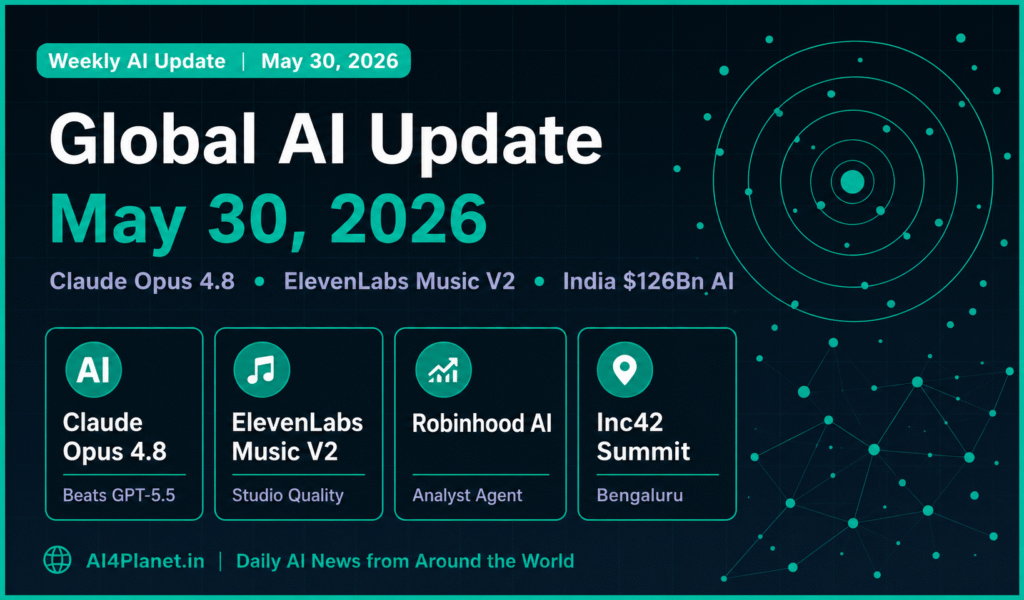

The pace of AI releases this week was genuinely relentless. Anthropic dropped Claude Opus 4.8 — just 41 days after Opus 4.7 — and it outperforms OpenAI’s GPT-5.5 and Google’s Gemini 3.1 Pro on key benchmarks. ElevenLabs pushed AI music into studio territory. Robinhood launched an AI stock analyst that works like a personal Wall Street intern. And Higgsfield plugged AI video directly into Adobe Premiere Pro. If you blinked, you missed three product launches. Here’s everything that matters this week — clearly and quickly.
🧠 1. Claude Opus 4.8 Released — Beats GPT-5.5 Just 41 Days After 4.7
On May 28, Anthropic released Claude Opus 4.8 — its fastest major model upgrade yet, arriving just 41 days after Opus 4.7. The speed signals both competitive urgency and real technical progress. Anthropic describes 4.8 as having “sharper judgment, more honesty about its progress, and the ability to work independently for longer” than its predecessors.
The benchmark results are meaningful. Agentic coding score jumped from 64.3% to 69.2%. Multidisciplinary reasoning with tools climbed from 54.7% to 57.9%. On Finance Agent v2, Opus 4.8 outperformed both OpenAI’s GPT-5.5 and Google’s Gemini 3.1 Pro. Two new capabilities are particularly notable. Dynamic Workflows lets Claude Code plan large tasks and run hundreds of parallel sub-agents in a single session — a major upgrade for enterprise coding workflows. Effort Control lets users on claude.ai and Cowork set exactly how much thinking Claude applies to each task, directly controlling token usage and cost.
Pricing stays the same as Opus 4.7 — $5 per million input tokens and $25 per million output tokens. Fast Mode at 2.5× speed is $10/$50 and is three times cheaper than previous fast modes. Anthropic also confirmed its roadmap: cheaper Opus-grade models are in development, and Mythos-class models will reach customers once stronger cybersecurity safeguards are in place.
“Opus 4.8 is more likely to flag uncertainties about its work and less likely to make unsupported claims — roughly four times less likely than 4.7 to let coding flaws slip through unflagged.”
— Anthropic, May 28, 2026
📌 Why it matters: A 41-day release cycle is unusually fast for Anthropic — this is a direct competitive response to OpenAI’s Codex and Google’s Gemini Flash launches in the same period. The honesty improvements (flagging its own uncertainty) are also a meaningful step toward AI you can actually trust in production environments.
🎵 2. ElevenLabs Music V2 — AI Music Has Officially Entered the Studio
ElevenLabs — best known for AI voice generation — this week launched Music V2, and the upgrade is substantial enough to change how creators, brands, and app developers think about AI-generated audio. The new version brings sharper vocals, richer instrumentation, multilingual generation, section-level editing, sound effects, and commercially usable tracks — a complete audio workflow, not just a music toy.
The section-level editing is particularly significant. Previously, AI music tools produced a single output that you either used or discarded. Music V2 lets you edit specific sections — change the chorus, adjust the bridge, swap instrumentation in the intro — treating the AI output as a malleable composition rather than a finished product. For content creators building YouTube videos, podcasts, social media content, or apps, this removes one of the biggest remaining friction points in AI audio production.
📌 Why it matters: AI music has historically struggled with two problems — quality and control. Music V2 addresses both simultaneously. Combined with commercial licensing, this makes AI-generated music viable for professional content production for the first time at scale.
📈 3. Robinhood Launches AI Analyst Agent — Your Personal Wall Street Researcher
Robinhood this week launched an AI-powered stock analyst agent — a move that brings institutional-grade research capability directly to retail investors. The agent can analyse company fundamentals, synthesise earnings call transcripts, compare competitive positioning, and generate plain-English investment summaries on demand. Think of it as having a financial analyst on call 24/7, at no extra cost.
This sits alongside a broader wave of AI entering personal finance. Google Nano Banana 2 — Google’s fast, high-volume image and content model — also landed this week, giving creators stronger control over text generation, multilingual assets, and polished content output for everyday workflows. The week also saw Figma expand its AI design capabilities, with smarter auto-layout suggestions and AI-powered component generation built directly into the design tool.
📌 Why it matters: Robinhood’s 23 million users now have access to the kind of financial analysis that previously cost thousands per month through Bloomberg terminals or professional advisory services. When AI democratises Wall Street research, it fundamentally shifts the information advantage between retail and institutional investors.
🎬 4. Higgsfield Brings AI Video Inside Adobe Premiere Pro — No More Tab Switching
One of the most practically useful launches of the week: Higgsfield released Adobe Premiere Pro and After Effects plugins that bring AI video generation directly into the editing timeline. Video editors can now generate images, create video clips, apply transitions, reframe shots, remove backgrounds, use draw-to-edit tools, and upscale footage to 4K — all without leaving Premiere Pro.
This is significant because the biggest friction in AI-assisted video production has been the constant context-switching between AI tools and editing software. Higgsfield’s integration removes that entirely. For professional video editors, the workflow improvement alone — regardless of the AI quality — is a meaningful productivity gain. Alongside this, YouTube expanded its AI-powered features for creators, including smarter chapter generation, AI-assisted thumbnail suggestions, and experimental AI podcast tools that can summarise long-form content into structured audio episodes.
📌 Why it matters: The future of creative software is AI embedded inside existing tools — not AI tools that exist in parallel. Higgsfield’s Adobe integration is a preview of how every major creative platform will evolve over the next 12–18 months.
🌐 5. XReal Smart Glasses, Meta’s AI Push & The Race for Your Face
XReal used its Google partnership this week to make the case that AI smart glasses are finally moving past the awkward prototype phase. Powered by Google’s Project Aura, XReal’s new glasses demo showed real-time AI object recognition, contextual information overlays, and navigation assistance — all without pulling out a phone. Meanwhile, Meta continued its aggressive AI push across WhatsApp, Instagram, and its Ray-Ban smart glasses platform, with expanded AI assistant capabilities rolling out across regions.
The smart glasses race is heating up in a way it wasn’t even six months ago. Google’s XR glasses announced at I/O, Samsung’s Galaxy Glass, Meta’s Ray-Ban 3, and XReal’s Aura-powered device are all targeting the same window: 2026–2027 as the year wearable AI becomes genuinely useful rather than a novelty. The hardware is catching up to the ambition.
📌 Why it matters: When AI moves from your phone screen to your field of vision, the interaction paradigm changes entirely. The companies that win the smart glasses race won’t just sell hardware — they’ll own the most intimate computing interface humans have ever used.
📋 This Week at a Glance
| Story | What Happened | Impact |
|---|---|---|
| Claude Opus 4.8 | Released May 28 — beats GPT-5.5, Dynamic Workflows | 🔴 Critical |
| ElevenLabs Music V2 | Studio-quality AI music with section-level editing | 🔴 High |
| Robinhood AI Analyst | Personal stock research agent for 23M retail investors | 🔴 High |
| Higgsfield + Adobe | AI video generation inside Premiere Pro & After Effects | 🟡 High |
| XReal + Google Aura | Smart glasses demo signals wearable AI maturing | 🟡 Medium |
| Google Nano Banana 2 | Fast, high-volume AI image model for everyday creation | 🟡 Medium |
✍️ Editor’s Take
The most interesting pattern in this week’s news isn’t any single product — it’s the integration story. AI is no longer launching as standalone tools that sit alongside your existing workflow. It’s embedding itself inside Premiere Pro, inside Robinhood, inside WhatsApp, inside your editing timeline. That’s a fundamentally different distribution strategy, and it’s working. The tools that win won’t be the ones with the best AI — they’ll be the ones that disappear most seamlessly into the software you already use every day.
And Claude Opus 4.8 releasing 41 days after 4.7 is a signal worth taking seriously. Anthropic is sprinting. The IPO clock is ticking. And the model that’s ahead on benchmarks this week may not be ahead next month. Welcome to the fastest technology race in human history.
Follow our AI4Planet Weekly News and IndiaAI Mission pages for updates every week. Drop your story tips in the comments — we read every one.
Tags: Global AI Update May 2026, Claude Opus 4.8, Anthropic new model, ElevenLabs Music V2, Robinhood AI analyst, Higgsfield Adobe Premiere Pro, XReal smart glasses Google Aura, Google Nano Banana 2, AI news May 30 2026, weekly AI news