
Every week, AI makes another giant leap — and this week was no different. From a landmark deal between OpenAI and one of the world’s biggest pharma companies, to the U.S. government quietly stepping into the AI testing room, the headlines of May 2026 are reshaping what artificial intelligence means for healthcare, regulation, and business. Let’s break it all down — simply, clearly, and with no fluff.
🧬 1. OpenAI + Novo Nordisk: AI Is Now in the Drug Lab
In one of the biggest AI-healthcare partnerships of 2026, Novo Nordisk — the Danish pharmaceutical giant behind Ozempic and Wegovy — has announced a full-scale strategic partnership with OpenAI. The deal covers everything from drug discovery and clinical trials to manufacturing, supply chain, and commercial operations.
The goal? Get life-saving treatments to patients faster than ever before. OpenAI’s models will help Novo’s scientists analyse vast datasets, spot drug candidates earlier, and compress the years-long journey from lab bench to patient bedside.
“Integrating AI in our everyday work gives us the ability to analyse datasets at a scale that was previously impossible, identify patterns we could not see, and test hypotheses faster than ever.”
— Mike Doustdar, CEO, Novo Nordisk
OpenAI CEO Sam Altman added that AI “can help people live better, longer lives” in life sciences — and this deal is a strong signal the era of AI-led drug discovery is truly here. Pilot programmes are launching across R&D, manufacturing, and commercial ops, with full company-wide integration targeted by end of 2026. The partnership also includes upskilling Novo’s 68,800-strong global workforce in AI literacy.
📌 Why it matters: Big Pharma is placing massive bets on AI. Global pharma AI investment is expected to hit $2.51 billion in 2026. Novo Nordisk’s move signals that AI is no longer just a research experiment — it’s becoming the backbone of how medicines are built.
🏛️ 2. U.S. Government Now Tests AI Before It Reaches You
In a landmark shift for AI governance, Google DeepMind, Microsoft, and Elon Musk’s xAI have signed agreements with the U.S. government’s Center for AI Standards and Innovation (CAISI) — allowing federal authorities to evaluate their frontier AI models before public release.
OpenAI and Anthropic, who had existing evaluation partnerships since 2024, renegotiated their deals in line with the Trump administration’s AI Action Plan. This means that every major U.S. frontier AI lab now participates in voluntary pre-deployment government evaluations. CAISI has already completed over 40 model assessments, including unreleased, state-of-the-art systems.
The trigger? Anthropic’s powerful new model Claude Mythos Preview — described as “far ahead” of other models in cybersecurity — raised enough eyebrows that Anthropic itself chose to restrict public access and brief senior White House officials before any wider rollout.
📌 Why it matters: The “move fast and break things” era of AI is officially over. Governments are moving from the sidelines to the front row — and for the first time, the world’s most powerful AI tools will face a safety check before they reach the public.
💼 3. The Rise of the Chief AI Officer (CAIO)
AI isn’t just changing what companies build — it’s changing who runs them. Across the globe, organisations are creating a brand-new C-suite role: the Chief AI Officer (CAIO). As AI blurs the lines between the CTO, CIO, and CDO, companies are finding they need a dedicated executive to own AI strategy, governance, and integration.
A McKinsey partner described the moment plainly: “AI is driving what may be the largest organisational shift since the industrial and digital revolutions.” Meanwhile, a 2026 AI & Data Leadership survey found that 93.2% of executives cite cultural challenges — not technical limitations — as the biggest hurdle to AI adoption.
📌 Why it matters: AI adoption is ultimately a people problem. Companies that invest in culture, upskilling, and leadership alongside the technology will pull ahead. Those that don’t risk automating themselves into confusion.
⚡ 4. NVIDIA & IREN: 5 Gigawatts of AI Infrastructure Is Coming
NVIDIA and IREN have announced a major strategic partnership to accelerate the deployment of up to 5 gigawatts of next-generation AI infrastructure. IREN, a vertically integrated AI Cloud provider, will scale large data centres and GPU clusters across North America, Europe, and Asia-Pacific — all powered by renewable energy.
This is part of the broader “Gigawatt Era” — the industry term for the staggering compute infrastructure now needed to run frontier AI models at scale. As AI models grow more capable, the energy and compute demands behind them are growing at the same pace.
📌 Why it matters: AI’s future is built on physical infrastructure. Data centres, chips, and power grids are the new oil fields — and whoever controls compute controls the future of AI.
🔬 5. AI Is Learning to Speak Science — Literally
Scientists at the University of Pennsylvania have introduced Mollifier Layers, a new technique that integrates classical mathematics into neural networks to solve complex equations with far greater stability. Separately, researchers have shown that quantum computing combined with AI can dramatically improve predictions of chaotic systems — opening new doors in climate science, finance, and physics.
And in perhaps the most human-sounding AI research of the week, scientists discovered that everyday speech patterns — the pauses, the “ums,” the searching for words — are closely tied to executive brain function. AI is now being used to analyse speech to detect early signs of cognitive decline.
📌 Why it matters: AI isn’t just automating tasks — it’s accelerating fundamental science. The breakthroughs happening in labs today will define medicine, engineering, and physics for the next generation.
🗓️ This Week at a Glance
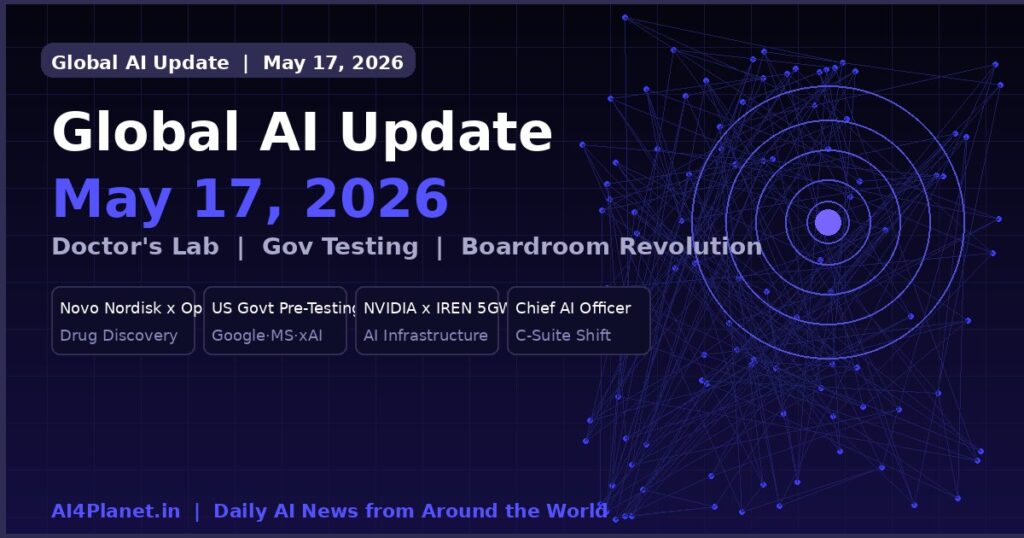
| Story | What Happened | Impact |
|---|---|---|
| Novo Nordisk × OpenAI | Full AI integration across pharma giant | 🔴 High |
| US Govt AI Testing | Google, Microsoft, xAI agree to pre-release reviews | 🔴 High |
| Chief AI Officer (CAIO) | New boardroom role emerges globally | 🟡 Medium |
| NVIDIA × IREN | 5GW AI infrastructure partnership | 🔴 High |
| AI + Science Research | Quantum AI, speech analysis breakthroughs | 🟡 Medium |
✍️ Editor’s Take
This week felt different. AI moving into drug discovery isn’t new — but a company the size of Novo Nordisk committing its entire global operation to OpenAI is a statement of intent few saw coming this boldly. And the US government stepping into the pre-release testing role? That’s AI growing up in real time. The technology is no longer just in the hands of labs and startups. It’s in boardrooms, government offices, and now — quite literally — the doctor’s laboratory.
The pace isn’t slowing. If anything, 2026 is proving to be the year AI stops being a feature and starts becoming the foundation.
Follow our AI4Planet Weekly News page and IndiaAI Mission page for daily updates. Have a story tip? Drop it in the comments below.
Tags: AI news May 2026, OpenAI Novo Nordisk drug discovery, US government AI testing, CAISI AI evaluation, Chief AI Officer CAIO, NVIDIA IREN AI infrastructure, quantum AI, AI healthcare 2026, Google DeepMind regulation, Anthropic Claude Mythos