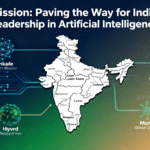

On 7 March 2024, the Government of India formally approved the IndiaAI Mission, marking the nation’s latest leap forward in its ambition to become a global leader in artificial intelligence. India Brand Equity Foundation+3Press Information Bureau+3Press Information Bureau+3 Building on earlier strategies, including NITI Aayog’s National Strategy for Artificial Intelligence #AIForAll (2018), the new framework seeks to democratise AI, address India-specific challenges, create employment, and provide regulatory guardrails to ensure AI systems are safe, trusted, and inclusive.
The Strategic Foundations: IndiaAI Mission and its Pillars
The IndiaAI Mission is structured around seven foundational pillars: (1) IndiaAI Compute, (2) IndiaAI FutureSkills, (3) IndiaAI Startup Financing, (4) IndiaAI Innovation Centre, (5) IndiaAI Datasets Platform, (6) IndiaAI Applications Development Initiative, and (7) Safe & Trusted AI. Press Information Bureau+2Press Information Bureau+2 These pillars are designed to build the necessary infrastructure (such as high-performance computing), nurture human capital with future-skills and training, support the startup ecosystem with finance and innovation opportunities, ensure access to high-quality datasets, drive development of AI applications tailored to Indian needs, and establish mechanisms for safety, trust, and responsible deployment.
Continuity and Evolution from #AIFORALL Strategy (2018)
India’s earlier document, National Strategy for Artificial Intelligence #AIForAll (published by NITI Aayog in 2018), laid the groundwork for today’s policies. It recommended focus sectors such as healthcare, agriculture, education, smart cities, infrastructure, mobility & transport, and proposed strengthening research, reskilling, ethical frameworks, data governance, and international collaboration. NITI Aayog+2datagovhub.elliott.gwu.edu+2 The IndiaAI Mission builds on this by specifying implementation mechanisms, funding, legal/regulatory tools, and anchoring objectives in current digital infrastructure.
Regulatory and Ethical Safeguards
To ensure that AI development does not proceed irresponsibly, Indian policy has introduced several legal and institutional safeguards:
-
First, under the IT Act, 2000 and more recent laws like the Bharatiya Nyay Sanhita, 2023, certain acts like identity theft, deepfakes, and impersonation are criminalised. Press Information Bureau+1
-
The Digital Personal Data Protection Act, 2023, provides a legal framework for data privacy. Press Information Bureau+1
-
CERT-In (the Indian Computer Emergency Response Team) has issued advisories and guidelines for best practices around AI use, and has introduced programs like “Certified Security Professional in Artificial Intelligence (CSPAI)” in September 2024. Press Information Bureau+1
-
A high-level advisory group under the Principal Scientific Adviser (PSA) to the PM has been constituted to work on a regulatory AI framework geared specifically to Indian realities. Press Information Bureau
Opportunities and Gaps: What Needs to Be Strengthened
While the strategy is ambitious and well-structured, several studies and experts point out gaps that could impede India’s ability to truly assume global leadership in AI:
-
Talent & R&D capacity: There remains a shortage of researchers, PhDs, and advanced research labs particularly in frontier AI research. Carnegie Endowment
-
Data availability and quality: For many Indian languages, domains (health, agriculture etc.), or sectors, usable datasets are scarce or fragmented. IndiaAI’s datasets pillar aims to improve this, but scaling remains a challenge. Press Information Bureau+1
-
Bridging academia-industry gap: Translational research—turning research into usable applications—needs more investment, collaboration, and smoother pathways. Carnegie Endowment+1
-
Regulatory agility: The pace of AI development globally is fast. Ensuring that regulatory frameworks are able to adapt without stifling innovation is a delicate balancing act. Carnegie Endowment+1
Impacts and Future Directions
If fully realised, India’s strategy could have wide-ranging impacts:
-
Economic growth & job creation: The AI-powered economy promises new industries, enhanced productivity in traditional sectors, and opportunities for millions of skilled workers.
-
Inclusive development: By addressing local challenges (e.g. in agriculture, healthcare, education) and ensuring access (both infrastructure and skills), AI has the potential to reduce disparities between regions and social groups.
-
Global collaboration and leadership: India’s participation in AI rankings, open-source infrastructure (such as AIRAWAT hosting open AI models), and its growing community of developers contribute toward recognition and influence in multilateral tech governance. Press Information Bureau+2India Brand Equity Foundation+2
Conclusion
India’s AI strategy, centred on the IndiaAI Mission and anchored in earlier policy visions like #AIFORALL, clearly signals the country’s aspiration to be not just a consumer but a creator and leader in the global AI arena. With the right investment, regulatory flexibility, and efforts to fill current gaps, India has the potential to be among the top AI nations—combining innovation with inclusive growth. The coming years will test how policy, private sector, academia, and civil society collaborate to translate this vision into reality.
References
-
National Strategy for Artificial Intelligence #AIForAll, NITI Aayog, 2018. NITI Aayog+1
-
IndiaAI Mission approved 7 March 2024; seven pillars of strategy. Press Information Bureau+2Press Information Bureau+2
-
Press Information Bureau releases, July 2025, statements by Ministry of Electronics & IT. Press Information Bureau+1
-
Reports on missing gaps: “The Missing Pieces in India’s AI Puzzle: Talent, Data, and R&D” (Carnegie Endowment, Feb 2025)