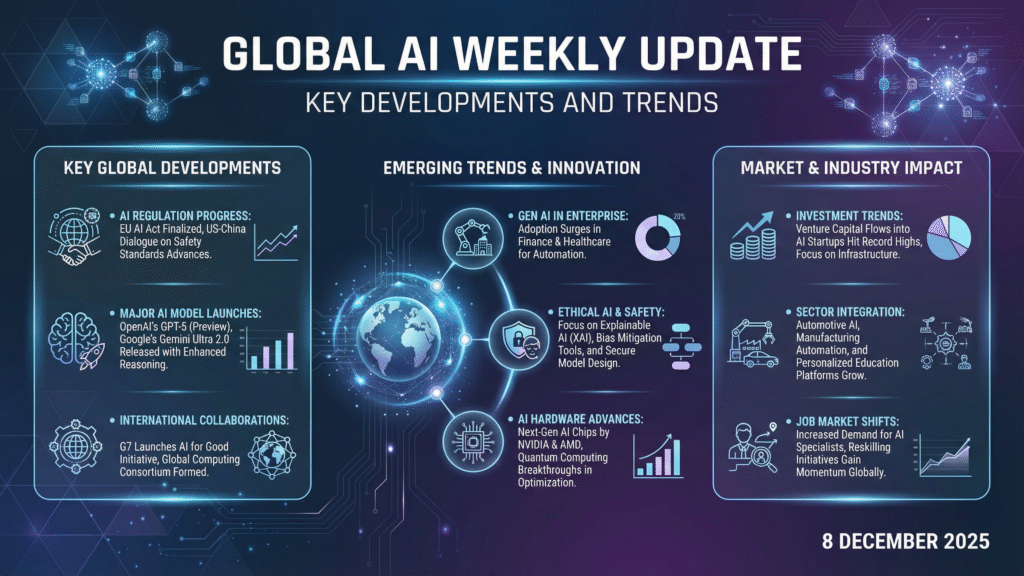

The global artificial intelligence landscape continues to evolve at a rapid pace. From major model launches and billion-dollar investments to regulatory guidance and ethical debates, the week of 8 December 2025 delivered several important updates shaping the future of AI. Here’s a comprehensive, fact-checked snapshot of the most impactful developments worldwide.
Breaking AI News
Google Unveils Gemini 3 and Gemini 3 Pro
Google officially launched its Gemini 3 and Gemini 3 Pro AI models, showcasing significant improvements in reasoning ability, coding accuracy, and enterprise productivity. These models are deeply integrated across Google Search and Workspace, enhancing real-world usability.
In addition, Google introduced “Antigravity,” an agentic coding platform designed to help developers automate complex software workflows—marking a strong push into AI-powered development tools.
Meta Expands Paid Data Licensing for AI Training
Meta announced multiple paid content-licensing agreements with leading news organizations, including USA Today, CNN, and Fox News. This move reflects a growing industry shift toward proprietary and licensed datasets for training generative AI models, reducing reliance on scraped public data and addressing copyright concerns.
Nvidia Invests $2 Billion in Synopsys
Nvidia made a strategic investment of approximately $2 billion in Synopsys, a leader in electronic design automation (EDA) software. The partnership aims to accelerate the design of AI-optimized chips, enabling faster development of specialized processors for high-performance AI workloads.
Regional AI Developments
Australia Accelerates Enterprise AI Adoption
Virgin Australia and retail giant Wesfarmers announced large-scale partnerships with OpenAI to integrate generative AI into customer service, retail operations, and internal workflows. These initiatives highlight Australia’s growing momentum in enterprise AI adoption.
Oregon Launches AI Startup Accelerator
An AI Accelerator program in Oregon, backed by Google and regional partners, was officially launched to support early-stage AI startups. Applications are open until mid-December 2025, with the first pilot cohort scheduled to begin in early 2026.
Canada Pilots AI-Enabled Police Body Cameras
The city of Edmonton, Canada, began testing AI-powered police body cameras capable of matching faces against a “high-risk” watch list. The pilot has reignited debates around live facial recognition, privacy, and public safety across North America.
AI Research and Innovation Breakthroughs
AI Reshaping Scientific Research
A new Nature report highlighted how AI tools are dramatically reducing the time and cost of scientific research—particularly in drafting papers, coding experiments, and data analysis. However, researchers also raised concerns around transparency, over-reliance on automation, and erosion of human skills.
Mistral AI Releases “Mistral Large 3”
French AI startup Mistral AI launched Mistral Large 3, a powerful multilingual large language model positioned as a high-end, general-purpose system. The model delivers strong performance across languages and remains effective even under limited connectivity conditions.
Rise of Sector-Specific AI Solutions
Industry-focused AI continues to gain traction. Neurologik’s “AI Workforce” platform for manufacturing demonstrates how AI can encode product rules, safety standards, and historical engineering data to automate complex industrial workflows.
Major Corporate AI Moves
OpenAI Faces Intensifying Competition
Industry reports indicate that OpenAI has declared an internal “code red”, accelerating improvements to ChatGPT amid growing competition from Google, Anthropic, and other AI labs. This reflects an increasingly intense race for model quality, speed, and enterprise adoption.
Meta’s Licensing Strategy Signals Industry Shift
By prioritizing paid and vetted datasets, Meta’s content-licensing approach may influence how other AI companies structure training data access and copyright compliance going forward.
Nvidia Strengthens AI Hardware–Software Ecosystem
Nvidia’s investment in Synopsys deepens vertical integration between GPU platforms and chip-design software, strengthening its long-term position in the AI hardware ecosystem.
Ethical, Legal, and Regulatory Updates
UNESCO Issues AI Guidelines for Courts
UNESCO released new guidelines on the use of AI in judicial systems, emphasizing that AI should support—not replace—human judges. The framework highlights transparency, fairness, contestability, and non-discrimination in AI-driven decision-support tools.
UNDP Warns of Global Job Displacement Risks
A UNDP report focused on the Asia-Pacific region warned that rapid AI adoption in wealthier economies could threaten millions of jobs in lower-income countries unless governments invest in skills development, social safety nets, and ethical AI deployment.
Academic Publishing Tightens AI Usage Rules
The journal Ethics announced a formal policy governing AI use in research submissions. The guidelines clarify acceptable and prohibited uses of AI tools, reinforcing emerging standards around academic integrity and responsible AI-assisted writing.
Final Takeaway
From advanced AI models and strategic investments to ethical safeguards and workforce concerns, this week’s developments underscore how quickly artificial intelligence is reshaping technology, business, and society. As competition intensifies and regulation evolves, the focus is clearly shifting toward responsible innovation, licensed data, and real-world deployment at scale.
Stay tuned for next week’s global AI update as the race for intelligent systems continues.
Follow our AI4Planet Weekly News page and IndiaAI Mission page for more updates.

